
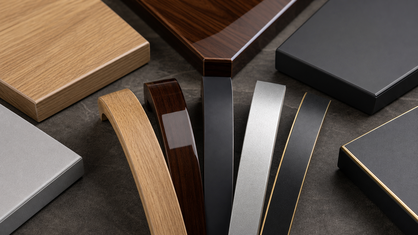
Finding the perfect custom edge banding color for your panel furniture can be a massive headache when colors look different online than they do in your hand. You spend weeks designing a beautiful cabinet line, only to have the finished edge banding arrive looking slightly off-tone or flat. We understand how frustrating mismatching colors can be for high-end furniture manufacturing, which is why we developed a foolproof color matching and approval process.
To approve a custom edge banding color, the customer first sends a physical board or banding sample to the manufacturer. The engineering team analyzes the sample to determine if specialized woodgrain rollers, embossing rollers, or custom extrusion molds are needed. Once a lab sample is formulated, matched, and verified under standardized lighting, the customer signs off on a physical "Golden Sample" to begin mass production.
Let us guide you through the exact steps we take to turn your raw design ideas or physical board samples into a perfectly matched, high-quality plastic edge banding. This structured journey ensures absolute color consistency from the first meter to the last.
Why is sending a physical sample the first step for a custom edge banding color?
Relying on digital photos or PDF color charts to match a custom edge banding color is a recipe for disaster. Cameras distort colors, computer screens display lighting differently, and ambient room lights skew visual perception.1
Sending a physical sample is crucial because it gives the color-matching lab an absolute reference point for color, gloss levels, and surface texture. We match the physical sample directly against your target board under standardized lighting cabinets to eliminate any optical illusions caused by digital screens.
In our twenty years of manufacturing plastic extrusion profiles at Guangzhou Shuo Tai, I have seen many instances where digital communication fell short. Once, an overseas customer sent us high-resolution smartphone photos of a beautiful natural oak board. The photos looked like a warm honey oak under their factory lights. However, when we manufactured the first batch based on those images and shipped it, the customer was dismayed to find the banding looked far too orange against their actual physical boards. That costly mistake taught us a permanent lesson: we always require a physical master sample.
When we receive your physical board sample, our laboratory team does not just look at it with the naked eye. We utilize several technical steps to break down the color:
- Spectrophotometer Analysis: This device measures the exact light wavelengths reflected from the sample surface, generating a precise color fingerprint (Lab* values).
- Standardized Light Box Testing: We view your sample under multiple standardized light sources, such as D65 (artificial daylight), TL84 (store lighting), and F (home lighting)2, to prevent metamerism—where colors match under one light but look completely different under another.3
- Surface Texture Evaluation: We inspect the physical profile to see if it requires a matte, semi-gloss, high-gloss, or textured finish.
How do we analyze rollers and molds for a custom edge banding color?
Getting the base color right is only half the battle when matching a complex custom edge banding color. If the woodgrain pattern is misaligned, the embossing texture is too shallow, or the metallic sheen is missing, the final furniture piece will look cheap and unfinished.
We analyze physical samples to determine if we need to open customized tooling, such as woodgrain print cylinders, textured embossing rollers, custom brand logo plates, or complex plastic extrusion profile molds. If our extensive inventory of existing rollers cannot achieve your exact design, we develop custom tooling to replicate the pattern.
At our manufacturing facility in Guangdong, we operate over 30 automated production lines. Over the years, we have built a massive library of print cylinders and embossing rollers. When a sample arrives, our engineers first cross-reference it with our existing library to see if we already have an exact or highly similar texture. This step saves our customers significant time and tooling costs.
However, many projects require bespoke solutions. If you need a unique wood grain pattern, an exotic texture, or a specific metallic finish, we must evaluate the necessary tooling:
- Woodgrain Rollers: For multi-colored woodgrains, we use rotogravure printing. This requires engraving steel cylinders (print rollers) with the exact grain pattern. Each color layer in the woodgrain requires its own roller.
- Embossing Rollers: To give PVC or ABS edge banding a realistic wood feel, tactile stone texture, or custom matte finish, we press the hot plastic through an engraved steel embossing roller.
- Logo Plates: If you want your company logo printed on the back of the banding for brand authentication, we must create a custom printing plate.
- Extrusion Molds: For custom-shaped profile edge bandings (like T-mouldings or U-channels), we must wire-cut a custom steel extrusion die to shape the plastic accurately.
Here is a breakdown of how different finish types affect tooling and development needs:
| Edge Banding Category | Tooling Requirement | Process Complexity | Primary Cost Driver |
|---|---|---|---|
| Solid Colors | Standard extrusion die, gloss level adjustment | Low to Medium | Raw material pigment matching |
| Woodgrain / Patterns | Print cylinders + Embossing roller | High | Engraving custom steel rollers |
| Metallic Colors | Metallic pigments + Specific texture roller | Medium | Specialty raw materials |
| Custom Profile Shapes | Custom extrusion mold (die) | High | Mold design and calibration |
How do you verify your custom edge banding color sample?
Signing off on a mass production run of thousands of meters of custom edge banding color can feel incredibly stressful. You do not want to risk receiving a massive container of stock that is slightly off-shade, causing production delays for your furniture factory.
To verify and approve your custom edge banding color, we send you a physical prototype sample produced on our pilot line. You test this sample directly on your panel laminates under your factory's specific lighting conditions and edge-banding machinery, confirming the color match, adhesion, and trimming quality before signing off.
Once our lab formulates the plastic compound and tests it in-house, we produce a physical sample run. We never recommend going straight from a laboratory formulation to full-scale production. Instead, we run a small trial on our pilot extrusion lines to generate real physical samples.
We then mail these physical samples to you. When you receive them, we advise taking the following steps to ensure a flawless match:
- Test Trimming and Scraping: Run our sample through your automatic edge banding machines. Check how the material behaves when cut and scraped. High-quality PVC and ABS from our Terrific New Material Technology lines should not show white stress marks (whitening) when scraped by your machine's trim blades.4
- Evaluate the Seam: Observe the glue line. A perfectly matched edge banding should blend seamlessly with the face laminate of your board, making the joint line virtually invisible.
- Check Color in Target Environments: Place the banded board under the actual lighting where the finished furniture will be used. View it from multiple angles to check the gloss and texture reflection.
Once you are completely satisfied with the sample, both parties sign off on what we call the Golden Sample. We keep one identical half in our quality control lab in Guangdong, and you keep the other half at your facility. This Golden Sample serves as our absolute quality reference point for all future production runs, ensuring that your tenth order matches your first order perfectly.
Frequently Asked Questions
How long does the custom edge banding color matching process take?
It typically takes 3 to 7 working days to formulate and produce a physical sample once we receive your master board or banding sample in our laboratory. Shipping times vary depending on your international location.
Do I have to pay for custom embossing rollers or print cylinders?
If we can match your design using our vast inventory of existing rollers, there are no tooling charges. If your project requires an entirely unique pattern or embossed texture, a one-time tooling fee is charged, which we often refund once your order volume reaches a set threshold.
Can you match metallic colors or high-gloss finishes?
Yes, we can. We formulate custom metallic edge bandings using high-grade metallic pigments to mimic aluminum, brushed steel, or gold. For high-gloss bandings, we apply a protective UV lacquer coating that ensures depth of color and scratch resistance.5
What materials are available for custom edge banding?
We manufacture custom profiles and edge bandings in PVC, ABS, and PMMA (acrylic). We can customize the thickness (usually from 0.4mm to 3.0mm) and width to suit your specific furniture production lines.
Conclusion
Getting your custom edge banding color approved does not have to be a stressful process. By starting with a physical board sample, performing detailed roller and mold analysis, and establishing a signed Golden Sample, we guarantee an exact match for your panel furniture. At Guangzhou Shuo Tai (now transitioning to Terrific New Material Technology), we combine 20 years of extrusion expertise with over 30 automated production lines to deliver flawless color consistency for furniture manufacturers and distributors worldwide. Contact our engineering team today to send your samples and start your next custom color matching project!
"The Eye of the Beholder: How Lighting Affects Our Color Perception", https://www.nist.gov/blogs/taking-measure/eye-beholder-how-lighting-affects-our-color-perception. Color-science guidance recognizes that the appearance and reproduction of color depend on illumination, viewing conditions, and the characteristics of imaging and display systems, so a digital image is not necessarily a color match to its physical subject. Evidence role: mechanism; source type: institution. Supports: Color appearance depends on illumination, observer, and display or imaging conditions; digital reproductions need not match a physical specimen.. Scope note: This supports the general risk of mismatch, not the magnitude of error for any particular camera, display, or room. ↩
"Standard illuminant", https://en.wikipedia.org/wiki/Standard_illuminant. Color-evaluation practice uses specified reference illuminants, including daylight and fluorescent simulators, to assess whether an apparent match remains acceptable across viewing conditions. Evidence role: definition; source type: institution. Supports: D65 and fluorescent illuminants are defined reference viewing conditions used in color evaluation, while TL84 is commonly used as a retail-fluorescent simulator in light booths.. Scope note: The exact designation and spectral implementation of a commercial light-booth source such as TL84 can vary by standard or manufacturer. ↩
"Standard illuminant", https://en.wikipedia.org/wiki/Standard_illuminant. Metamerism describes the condition in which spectrally different samples appear to match under one illuminant or observer condition but cease to match when the viewing condition changes. Evidence role: definition; source type: encyclopedia. Supports: Metameric samples can have different spectral reflectance functions yet appear to match under one set of viewing conditions and not another.. Scope note: The definition explains the phenomenon but does not establish the frequency of metamerism in a particular edge-banding product. ↩
"Stress Whitening as an Observation Method of Residual Stress in MABS ...", https://pmc.ncbi.nlm.nih.gov/articles/PMC7760271/. Stress whitening is a documented polymer-deformation phenomenon in which mechanically induced microstructural changes scatter light and make a stressed region appear pale or white. Evidence role: mechanism; source type: paper. Supports: Stress whitening in polymers can arise from deformation-related microstructural changes, such as crazing, cavitation, or light scattering.. Scope note: Its occurrence during trimming depends on the specific resin, additives, temperature, blade condition, and processing settings. ↩
"Mechanical and Chemical Resistance of UV Coating Systems ...", https://pmc.ncbi.nlm.nih.gov/articles/PMC10304988/. Research on UV-curable coatings reports that appropriately formulated and cured films can provide protective surface properties, including resistance to scratching and abrasion. Evidence role: general_support; source type: paper. Supports: UV-curable coating systems are used as protective finishes and can be formulated to provide scratch- and abrasion-resistant surfaces.. Scope note: Scratch resistance and visual depth are formulation- and cure-dependent and require product-specific testing rather than being guaranteed by UV coating alone. ↩